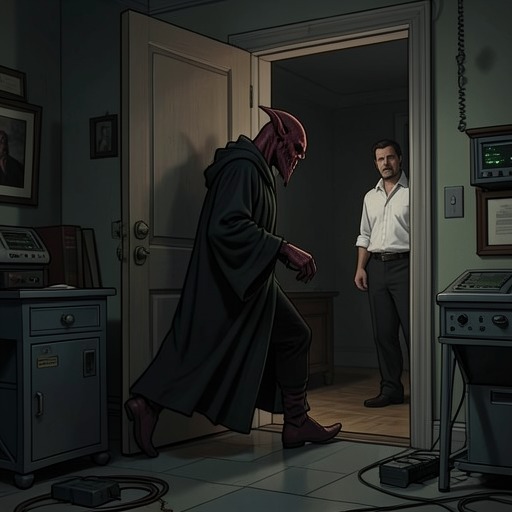
Wormwood
The Screwtape LettersWormwood is the junior tempter whose correspondence with his uncle, Screwtape, forms the book’s central frame. He is assigned to turn the patient away from Christianity and ultimately to deliver him to Hell, but his successive failures culminate in the patient’s death and entry into Heaven. Through Wormwood’s dependence on advice, his mistakes in the field, and Screwtape’s final promise to eat him, the letters show Hell’s hierarchy as an intimate version of its governing principle: the stronger self consumes the weaker.
Identity and Assignment
Wormwood appears first as the recipient of Screwtape’s instruction. The opening letter identifies his task as guiding the patient’s reading and encouraging him to spend time with a materialist friend; Screwtape rebukes him for relying on argument and teaches him to exploit fashionable labels instead. Wormwood’s work is therefore not presented as a contest of proofs, but as the management of attention, habits, and ideas about what seems strong or contemporary.
His assignment begins in difficulty: the patient has become a Christian. Screwtape says that this will bring the usual penalties, though he insists there is no reason to despair, since adult converts have been reclaimed before. He directs Wormwood to make use of the patient’s habits and of the visible, unimpressive features of the local congregation. The task is practical and sustained: undermine the new convert’s perception of Christianity by turning worship toward the people and objects he encounters in church.
Wormwood also receives orders about the demons’ own visibility. Screwtape reports that the High Command has ordered them, for the time being, to conceal themselves. The policy is difficult because disbelief in demons forfeits the effects of direct terror, while belief in them makes materialism harder to maintain. Wormwood is to keep the patient in the dark, exploiting the modern comic image of devils to make any suspicion seem ridiculous. This instruction places him within an organized infernal system, but the letters chiefly depict that system through his subordinate position and Screwtape’s supervision.
Methods and Repeated Failures
Screwtape’s letters treat Wormwood as a tempter who needs continual correction. When the patient becomes a Christian, the uncle warns him to work through ordinary habits and social impressions rather than expect a single decisive argument to undo the conversion. Elsewhere, Screwtape explains that the patient’s emotional and bodily life naturally rises and falls. The period of dryness Wormwood encounters is not itself his achievement; he must try to turn it to infernal advantage. The distinction matters: Wormwood is repeatedly tempted to mistake a circumstance for a victory, when the patient’s response to it remains decisive.
His record grows worse when the patient falls in love with a Christian woman. Screwtape learns of the relationship from a report that had failed to mention her, and responds with fury at Wormwood’s oversight as well as at the woman herself. The discovery becomes another sign of his inadequacy: the patient’s attachment has developed beyond the picture of him that Wormwood’s reporting conveyed. Screwtape’s extravagant abuse of the woman is not reliable evidence about her character; the preface explicitly cautions readers that Screwtape lies and that Hell’s portraits of human beings may reflect wishful thinking. What the outburst does establish is how sharply this relationship frustrates the tempter’s plans.
Wormwood’s most consequential failure comes during the patient’s first air raid. Screwtape says the patient was badly frightened and thought himself a coward, but nevertheless did everything duty required and perhaps more. Wormwood can report only the patient’s anger at a dog that tripped him, excessive cigarette smoking, and a forgotten prayer. Those lapses do not outweigh the patient’s conduct. Screwtape therefore rejects any appeal to Wormwood’s opportunities or intentions: infernal justice, he warns, judges results, and the failed tempter must either bring back food or become food himself.
Relationship with Screwtape
The correspondence presents Wormwood as both a subordinate under threat and the recipient of an uncle’s ostensibly affectionate attention. Screwtape’s guidance is never separate from discipline: he threatens penalties, mocks his nephew’s reports, and reminds him that failure has consequences. Even apparently protective language is unstable. In one letter, Screwtape reassures Wormwood that he will look after his interests while also warning him to keep the letters locked away, and he treats Wormwood’s maneuvering around infernal authorities as another offense rather than a reason for leniency.
The final letter overturns the expected meaning of their affectionate address. Wormwood asks, after everything has been lost, whether the endearments had ever meant anything. Screwtape answers that his love for Wormwood has been real, but immediately defines it as desire for a weaker being whom the stronger can consume. He expects the authorities to give Wormwood to him, or at least a part of him, and calls him a morsel. The endearments thus do not soften Hell’s hierarchy; they reveal it in miniature. For Screwtape, intimacy is not a bond between distinct selves but an appetite directed toward possession.
Defeat and Narrative Significance
The patient’s escape from Wormwood becomes visible through Screwtape’s account of the moment of death. The patient sees his tempter clearly and recognizes that Wormwood no longer has the part in him that he once held. Screwtape describes this recognition as a sudden clearing, followed by release from the patient’s earthly suffering. The bombs, falling houses, exhaustion, fear, and pain that filled the last moments of the patient’s life disappear, and Wormwood’s intended prey enters a new life instead.
The patient’s recognition extends beyond Wormwood. He sees the spiritual beings who had been present in his life when he thought himself alone, and his former doubts become, in Screwtape’s telling, ridiculous. He also sees God: what is suffocating fire to Screwtape is cool light and clarity to the patient, who can look upon God in human form. Screwtape distinguishes the patient’s self-knowledge from infernal pain; the patient’s awareness of sin does not prevent him from embracing what he encounters. The contrast makes Wormwood’s defeat more than a failed campaign. The human being he regarded as potential food enters a relationship that leaves him distinct rather than consumed.
Screwtape’s rage at the loss ties Wormwood’s personal failure to the book’s larger opposition between infernal competition and divine love. Hell understands existence as one self gaining at another’s expense; God’s purpose, as Screwtape unwillingly describes it, is to unite beings without erasing their distinctness. Wormwood loses because the patient’s freedom and continued existence are not absorbed into his tempter’s will. The final threat that Screwtape will consume his nephew completes the contrast: the patient is liberated into a life of recognition and communion, while Wormwood faces the very predation that his work was meant to impose on another.